The South Indian filter is one of the most forgiving brewing devices ever designed. It requires no electricity, no paper filters, and no pressure. What it requires is patience — and a respect for gravity.
The Equipment
You need a traditional two-chamber stainless steel or brass filter. The upper chamber has a perforated disc that holds the grounds. The lower chamber collects the decoction. The pressing disc is optional but useful for espresso-strength results.
The Grind
Use a medium-fine grind — finer than drip coffee, coarser than espresso. For Peaberry, err slightly coarser: the denser bean extracts efficiently even with a larger particle size. Pre-ground coffee works, but a burr grinder set to 15–18 on a 1–40 scale gives measurably better results.
The Ratio
Start with 2 tablespoons (approximately 12g) of coffee per 80ml of water. This produces a concentrated decoction meant to be diluted with hot milk. If you prefer a stronger cup, reduce water to 60ml. Do not increase the coffee-to-water ratio beyond 1:5 — you will extract bitterness instead of complexity.
The Water Temperature
This is where most home brewers err. Boiling water (100°C) scorches the surface proteins before extraction can complete, producing a flat, slightly bitter decoction. Pull your kettle off heat and wait 45 seconds. 92–95°C extracts cleanly.
The Wait
Pour slowly into the upper chamber. Replace the lid. Set a timer for 20 minutes. Do not press, do not shake, do not check every two minutes. Gravity is doing the work. The decoction drips through at its own pace, and that pace is correct.
The Dabarah Method
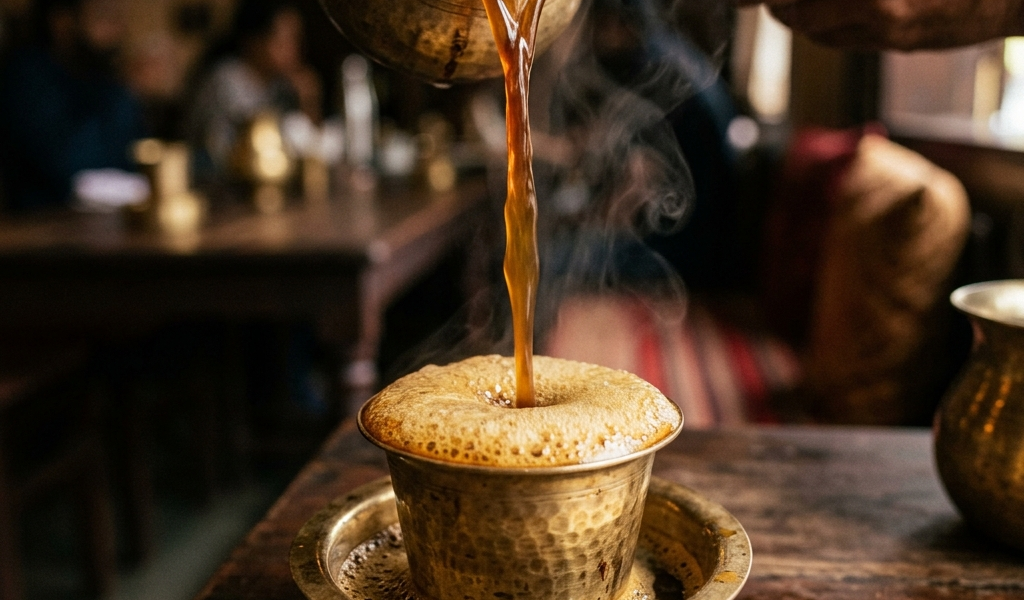
Pour 30ml of decoction into the tall tumbler. Add 120ml of full-fat milk, heated but not boiled. Then pour back and forth between the tumbler and the wide dabarah vessel from a height of 30cm — five to seven times. This aerates the coffee, cools it to drinking temperature, and creates the characteristic froth. That froth is not decoration. It is the final flavour layer.