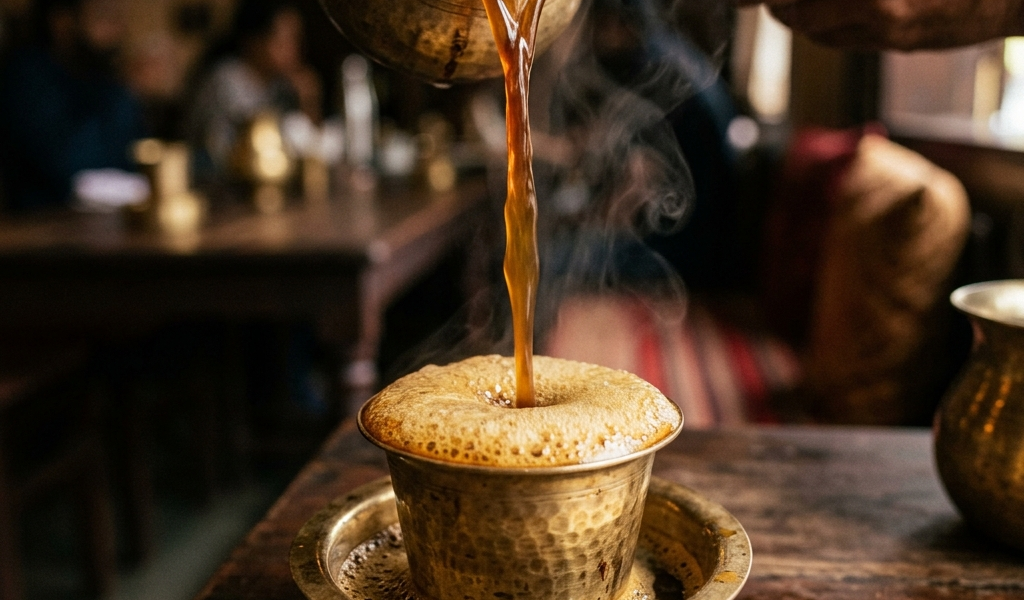
The South Indian filter decoction is one of the most reproducible coffee preparations that exists — once you understand its variables. It has fewer moving parts than pour-over, more predictability than French press, and a ceiling of quality that rivals espresso when the source material is correct.
Here is how each variable works.
Ratio: The Foundation
The standard ratio for filter decoction is 1:6 — one gram of coffee per six millilitres of water. This is a starting framework, not a fixed rule. Peaberry coffee extracts more efficiently and can be pushed to 1:7 without thinning the cup. Robusta blends, denser in caffeine but lighter in aromatic oils, often perform better at 1:5.
The decoction at this ratio is not meant to be consumed directly. It is a concentrate — intensely flavoured, almost syrupy — that will be diluted by hot milk at a 1:3 to 1:4 ratio in the final cup.
The Resting Phase
After the decoction drips through completely, most filters still hold 3–5ml of liquid in the grounds. Allow the filter to rest, undisturbed, for 5 additional minutes after apparent completion. During this time, the residual liquid — the highest-extraction, most aromatic fraction — finishes dripping.
Milk Temperature: The Underrated Variable
Milk heated above 75°C begins to denature its proteins, producing a slightly flat, cooked-milk flavour that overpowers the coffee’s aromatic compounds. Milk at 60–65°C, by contrast, carries its natural sweetness and integrates cleanly with the decoction.
The combined cup temperature after mixing decoction and milk should be approximately 62–65°C — the temperature that most people describe as “very comfortable to drink,” with no cooling wait required.
These variables, held consistently, make every cup of filter coffee reproducible. That repeatability is the mark of a craft understood rather than improvised.