Most coffee cherries contain two seeds, each with a flat face where they press against each other. These are the familiar flat-faced coffee beans sold commercially. A peaberry forms when only one seed develops inside the cherry — it grows rounder, denser, and absorbs the nutrient supply that would have been shared.
The result is a bean that behaves differently from the moment it enters the roaster to the moment it reaches your cup.
The Structural Advantage
A peaberry’s round shape means it rolls more consistently through a drum roaster. Standard flat beans have a tendency to stack unevenly, creating hot and cool zones within the batch. Peaberry beans roll freely, exposing their entire surface area to the drum heat in sequence, producing a more even roast from skin to centre.
Uneven roasting is the primary cause of the harsh, bitter edge common in commodity coffee. Peaberry’s structural advantage at the roaster translates directly to a cleaner cup.
Density and Extraction
Because the peaberry absorbed a single cherry’s full nutrient load, it is denser than a standard bean of the same variety. Higher density means more soluble content per gram — more sugars, more organic acids, more of the aromatic compounds that create complexity.
When you grind a peaberry and apply hot water, the extraction curve is extended: you pull more from each gram without hitting the over-extraction threshold. This is why peaberry filter coffee tends to finish sweeter and with more residual body than standard-bean coffee at the same dose.
What You Taste
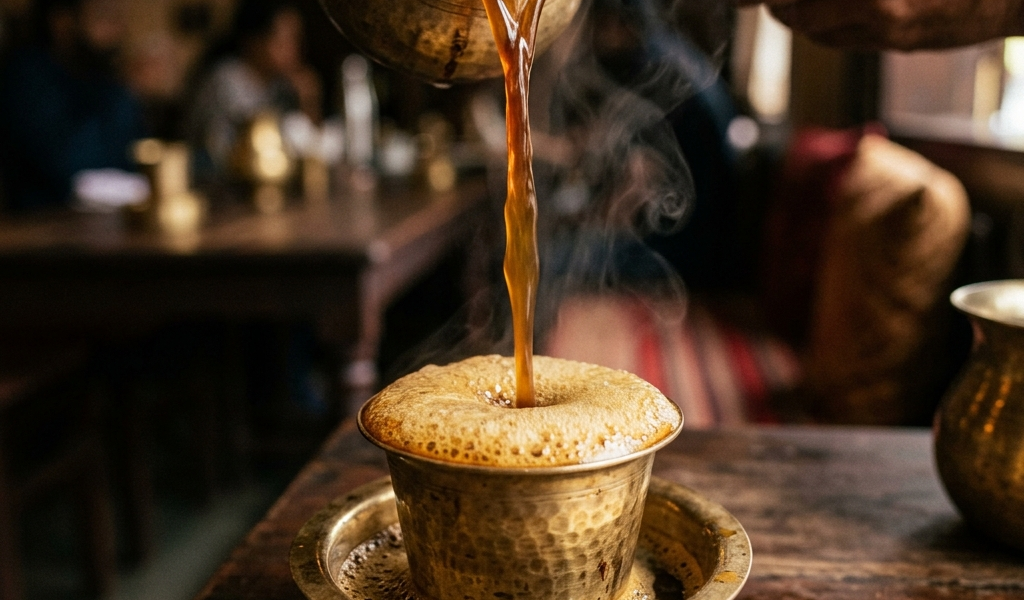
In a South Indian decoction context, peaberry produces what we describe internally as a “full-oval” cup. The flavour is round rather than sharp, with a honey-sweetness at mid-palate that balances the characteristic chicory depth. The finish is clean — no astringency, no aggressive bitterness.
This is the predictable output of structural and biochemical properties that are measurably different in the peaberry bean. Understanding why your coffee tastes the way it does is, we think, part of enjoying it properly.